If someone asked you the best way to unload a truck cargo container at a warehouse - and told you that giving the correct answer would win you at least $20 million - what would you say? Forklifts? A team of workers? Maybe a conveyor belt? (All with some sort of AI or automation mixed in, of course).
Now, imagine solving this problem at scale - across thousands of warehouses, where every minute of delay costs money. That's exactly the challenge robotics startups and venture capitalists are pouring billions into.
The logistics industry is plagued by inefficiencies, and truck unloading is one of the biggest bottlenecks. Idle trucks, waiting drivers, and congested loading bays add up to a staggering $800 billion problem.
While warehouse automation has surged in recent years, unloading remains stubbornly slow, labor-intensive, and inconsistent. U.S. startups are racing to fix it with three distinct approaches: automated pallet systems, AI-powered robotic arms for loose cargo, and autonomous forklifts. Leading the charge in each of these categories are Slip Robotics, Pickle Robot Co., and Fox Robotics.
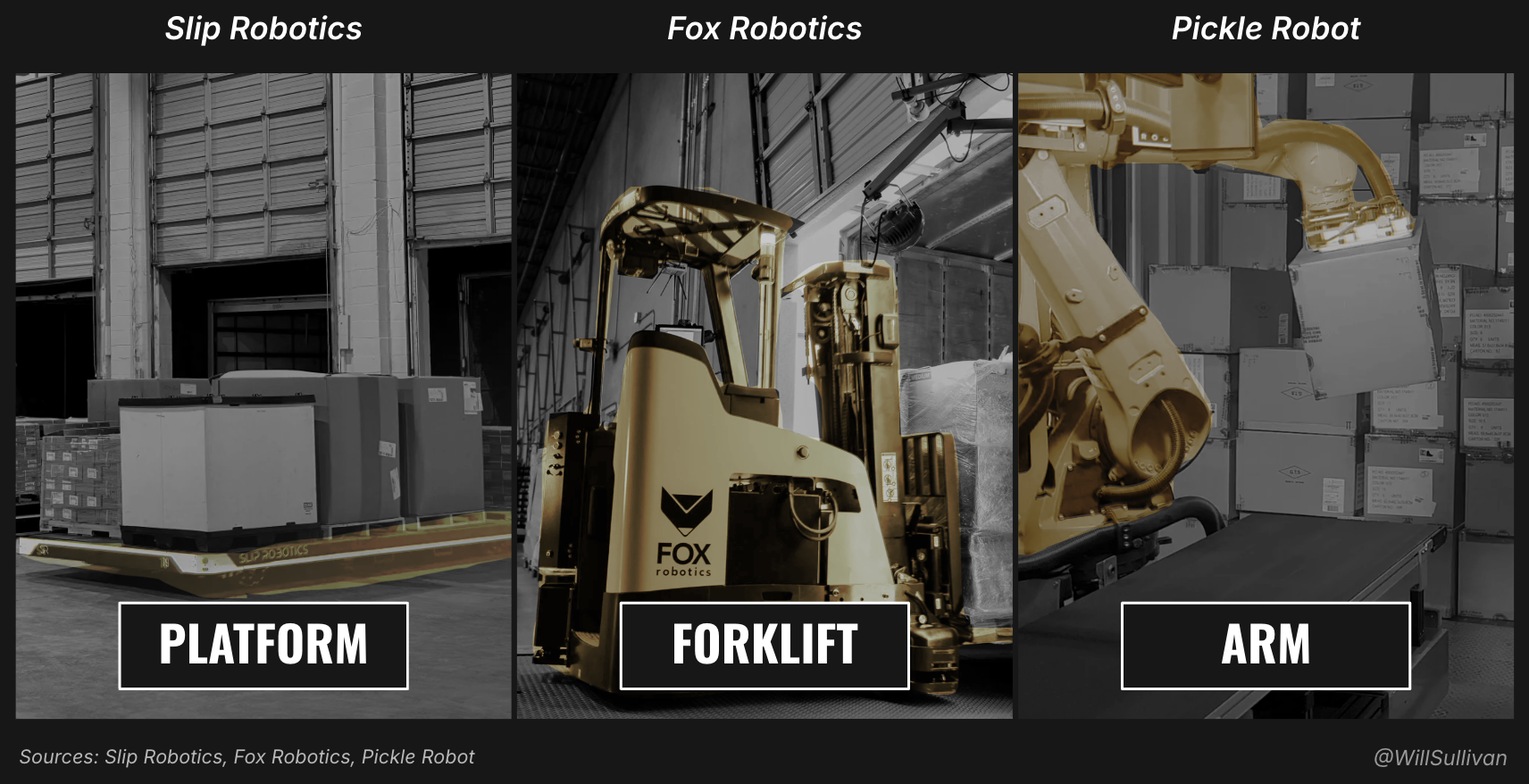
Slip Robotics, founded in 2020, has a simple but highly effective solution for unloading standardized pallets. Instead of forklifts moving goods one by one, their automated system slides entire pallets in and out of trailers in only a few minutes. (This short video does a good job of showing Slip's impressive system in action).
Investors have taken notice of the efficiency gains of systems like this, with Slip Robotics being last valued at $83 million. The company has raised more than $49 million, with its most recent funding being a $28 million Series B led by DCVC.
But Slip's technology only works for operations that rely on uniform, palletized goods - that's where Pickle Robot Co. comes in. Founded in 2018, Pickle's AI-powered robotic arms specialize in unloading loose-packed, irregularly shaped goods. Using computer vision and machine learning, their robots can identify, pick, and unload items from trailers in about 90 minutes - a significant improvement over manual labor.
Pickle Robot has raised $97 million to date, including a $50 million Series B led by Toyota Ventures, Ranpak, and Teradyne Robotics Ventures. Their valuation sits at $75 million as of late 2022. Unlike Slip's rigid system, Pickle's adaptable robots are ideal for e-commerce fulfillment centers, parcel shipping hubs, and any facility handling non-palletized goods.
For warehouses that already use pallets but want automation without a full system overhaul, autonomous forklifts present a middle ground. Startups like Fox Robotics are pushing this frontier. These AI-powered forklifts can operate independently while allowing human intervention when needed. Fox has raised over $76 million, most recently raising a $35 million Series B from existing investors like Walmart.
With billions at stake to solve this boring logistics problem, venture capitalists are betting big on which company will solve the unloading puzzle first. It's unlikely to be a winner-takes-all scenario, as different cargo types and the use of pallets demand varied solutions. However, Slip, Pickle, and Fox have each built a compelling case for their unique approach to solving the truck unloading challenge.
Learn more: SlipRobotics.com, PickleRobot.com, FoxRobotics.com
A version of this article was also published to my weekly email newsletter, The Burn Rate, on March 3, 2025. You can view that version of the article here.