Venture capital is a game of outliers - a power law business. This concept hinges on the reality that a small fraction of startup investments drive the vast majority of total returns, where the exceptional outweighs the average by orders of magnitude.
For venture as an asset class to make sense or be worthwhile, you need extraordinary return profiles to justify tying up capital for 8-10 years (more like 10-12+ years now, given limited M&A and IPO opportunities). These returns must outperform traditional capital markets, later-stage buyouts, and any other asset class to be worth the risk.
As renowned investor Vinod Khosla describes, venture capital is essentially "asymmetric options trading."
"For instance, OpenAI and AI as fields can turn out badly, but we [Khosla Ventures] buy an option with a great team and then work to help them succeed. You don't want to take low risks - you want to take very high risks. You can lose 1x your money, but if you can make 50x your money, even one out of 10 or one out of 20 times, you'll do fine."
How asymmetric is venture investing? Well, 48% of all VC investments don't return their capital or even pay back the value of the investment, which suggests that it needs to be highly asymmetric.
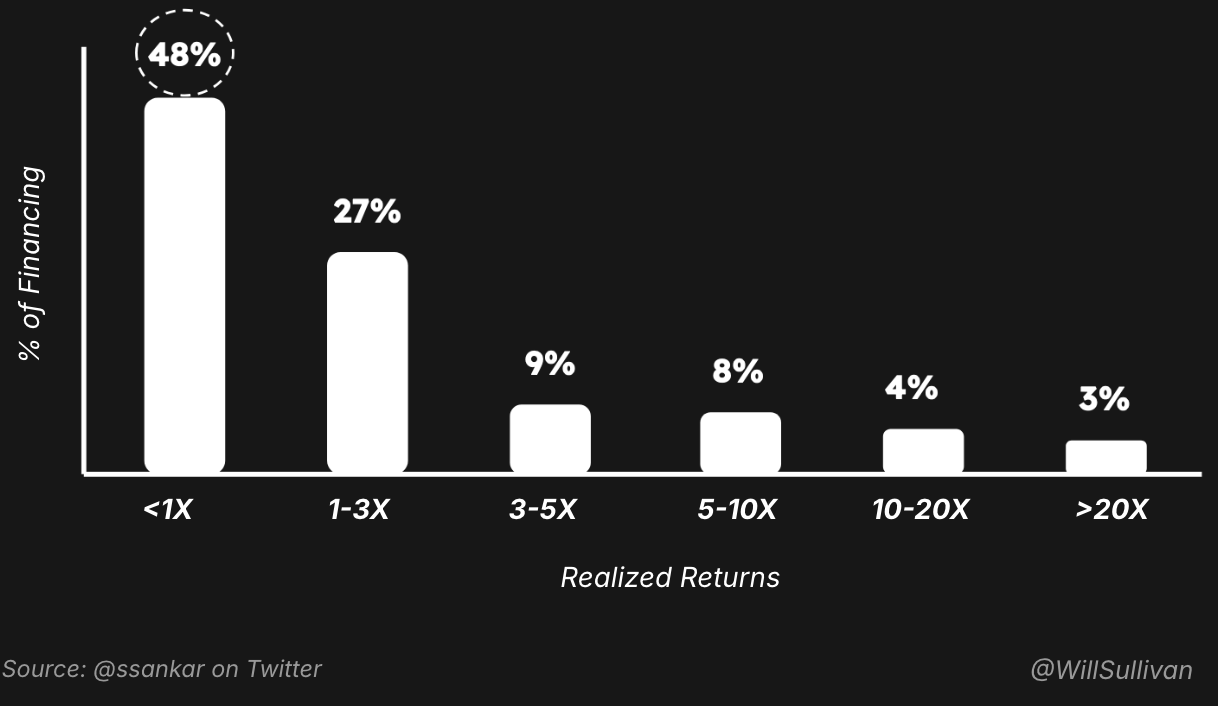 Venture has always been about asymmetric returns, with the great funds of today still achieving the power law outcomes.
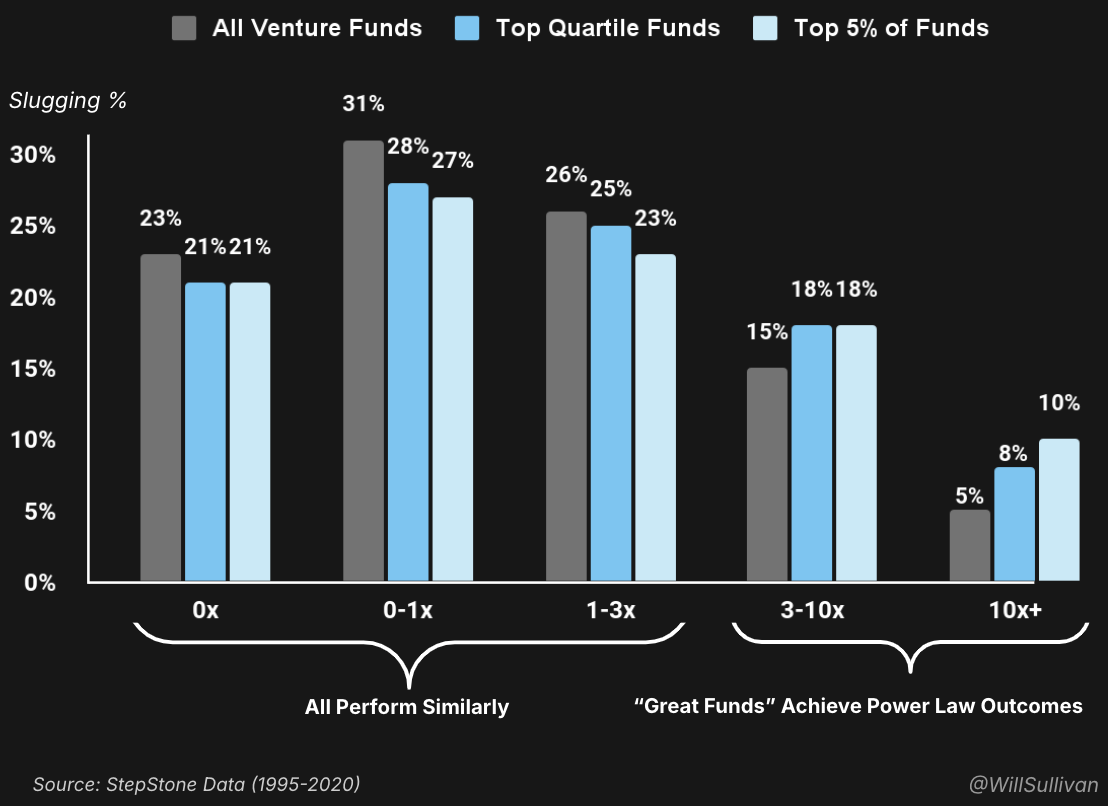
One might think the best way to achieve these outsized returns is to concentrate investments to the super-early stages (Seed or Pre-Seed), where the potential for growth is the greatest. But what's surprising is that there's still 1,000x upside potential at the Series A and Series B stages.
For example, Snowflake raised a Series B round at a $75M post-money valuation. Ten years later, their market cap was $75B. That's 1,000x in a decade. So, with the right companies, you can achieve 1,000x upside at Series A or Series B, while benefiting from much lower loss ratios as these startups are more established.
That said, the reality of venture capital is that most investments fail. Investors like USV partner Fred Wilson often reference the "1/3 Rule" to summarize return profiles: one-third of investments fail, one-third underperform, and one-third meet or exceed expectations.
Of the 3,400+ VC firms in the U.S., very few achieve power-law-level outcomes. What distinguishes great funds from good ones is their ability to secure investments with 10x+ returns.
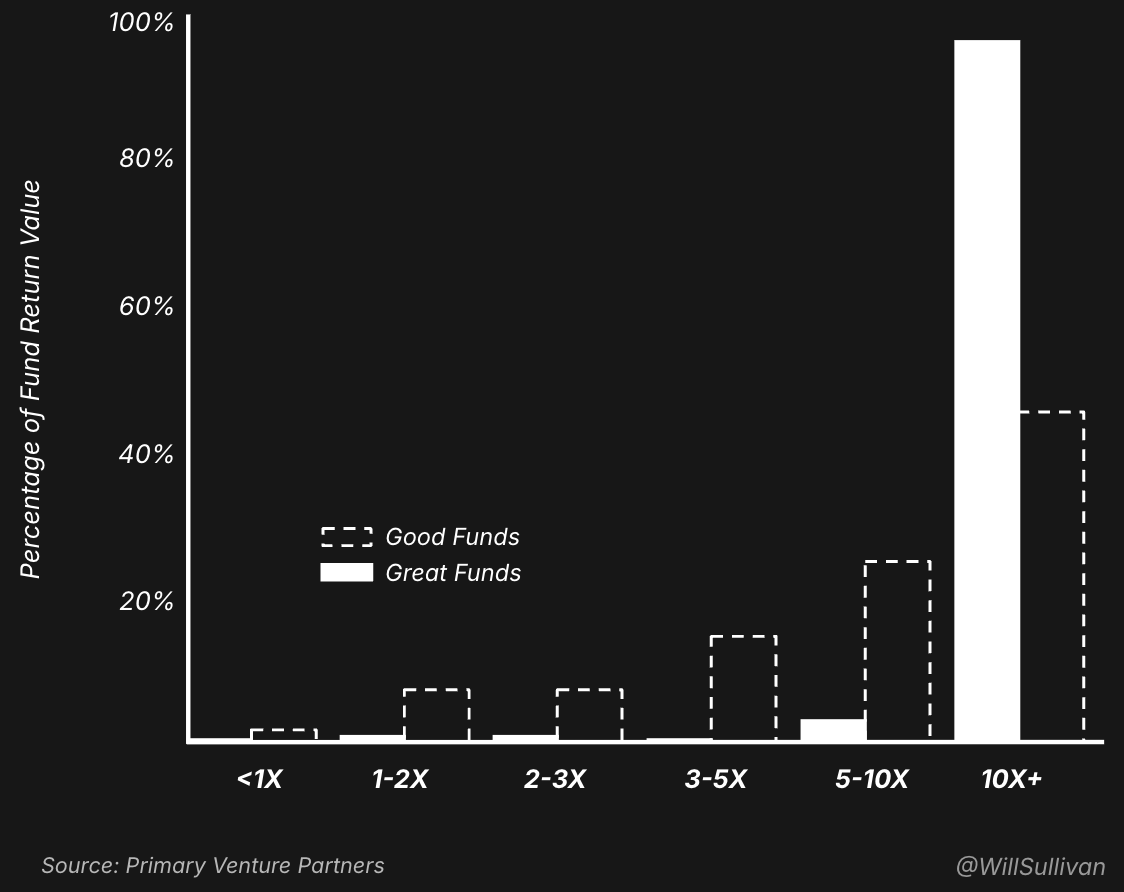
Building a portfolio capable of superior performance requires evaluating each investment with expected value analysis. Strikingly, leading thinkers across diverse fields - horse betting, casino gambling, and investing - emphasize a similar point: the Babe Ruth Effect: even though Ruth struck out frequently, he was one of baseball's greatest hitters.
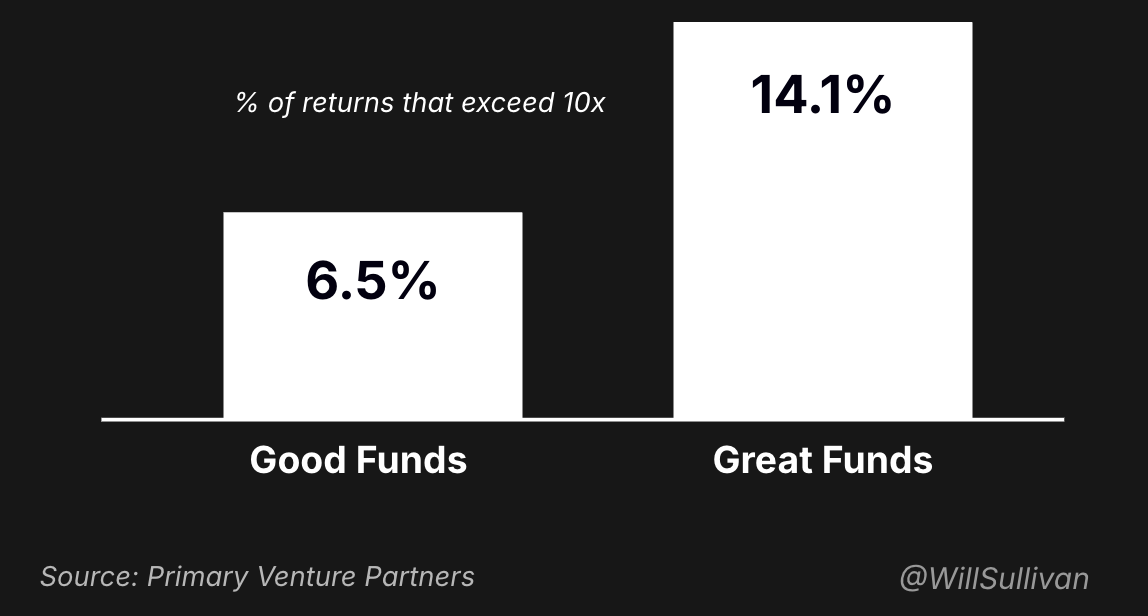
The disparity between good and great funds is further highlighted by the magnitude of these home runs. Winners in great funds produce outcomes nearly 2.5x larger than those in good funds.
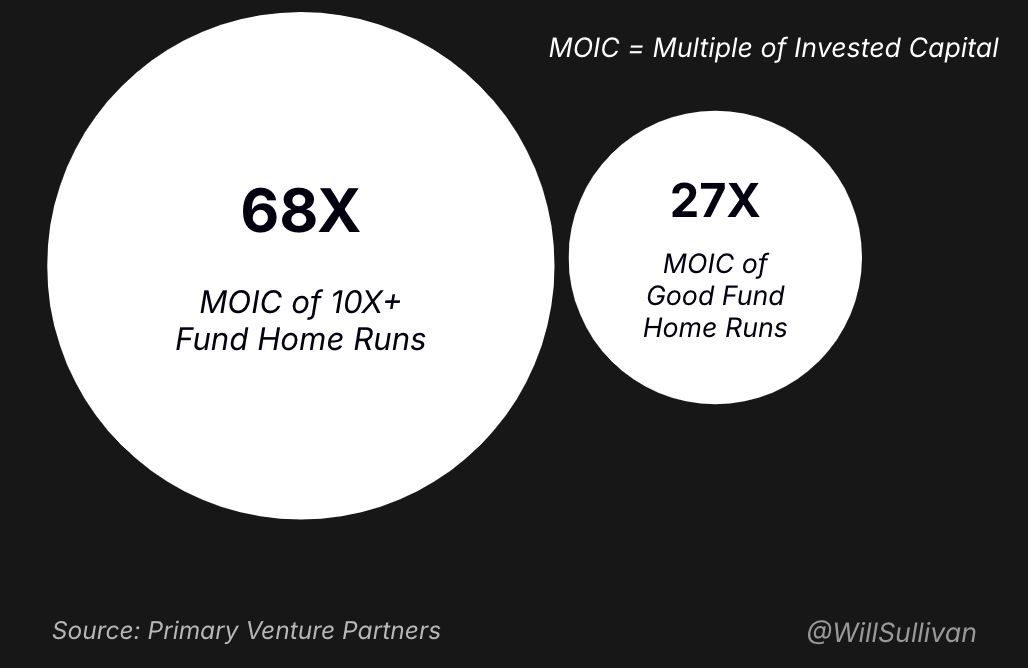
Despite these high upsides, even top-decile firms struggle to meet expectations. Nearly 75% of invested capital underperforms relative to underwriting projections, underscoring the critical role of power law dynamics.
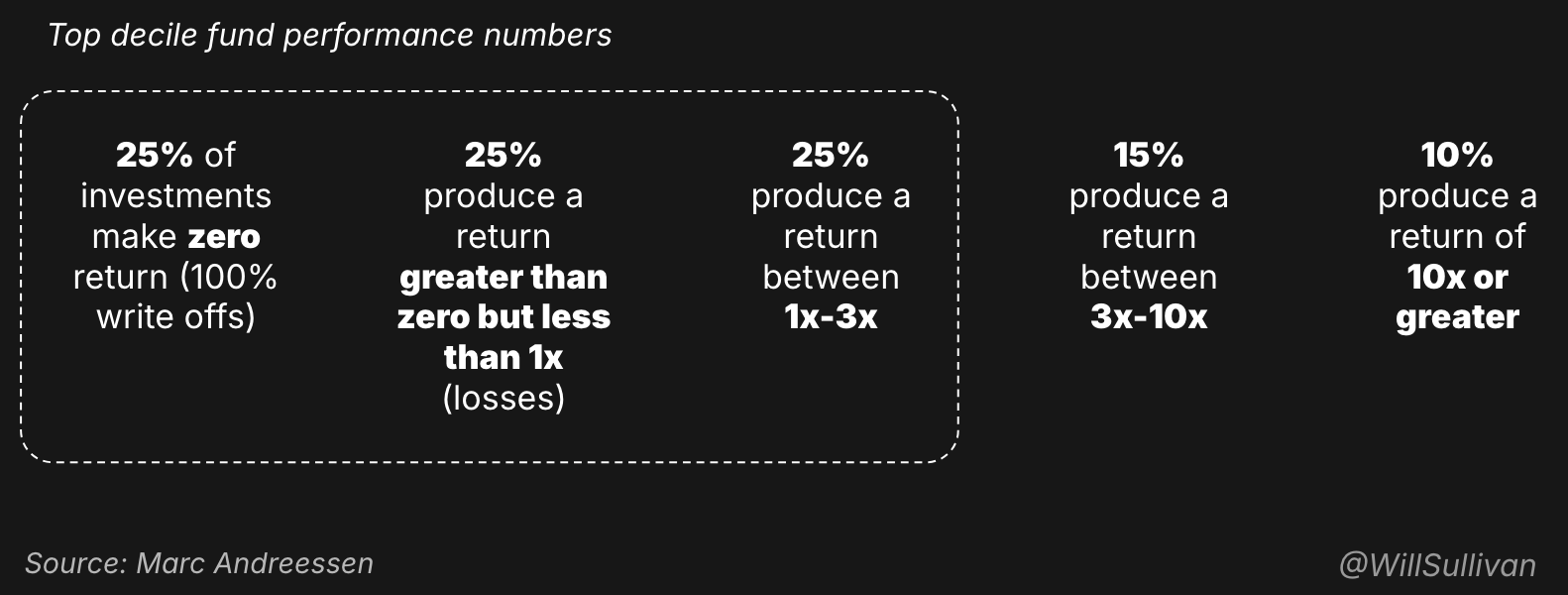
Ironically, great funds lose money slightly more often than good funds (48% vs. 46.3%), with higher loss ratios or percentage of investments that return less than the invested amount (0-1x). As Warren Buffett famously said, "Diversification may preserve wealth, but concentration builds it."
The same is true for venture capital. Great funds excel at concentrating capital effectively. If good funds could concentrate similarly, research suggests their returns could more than double (MOIC: 3.53x currently to a projected 8.13x).
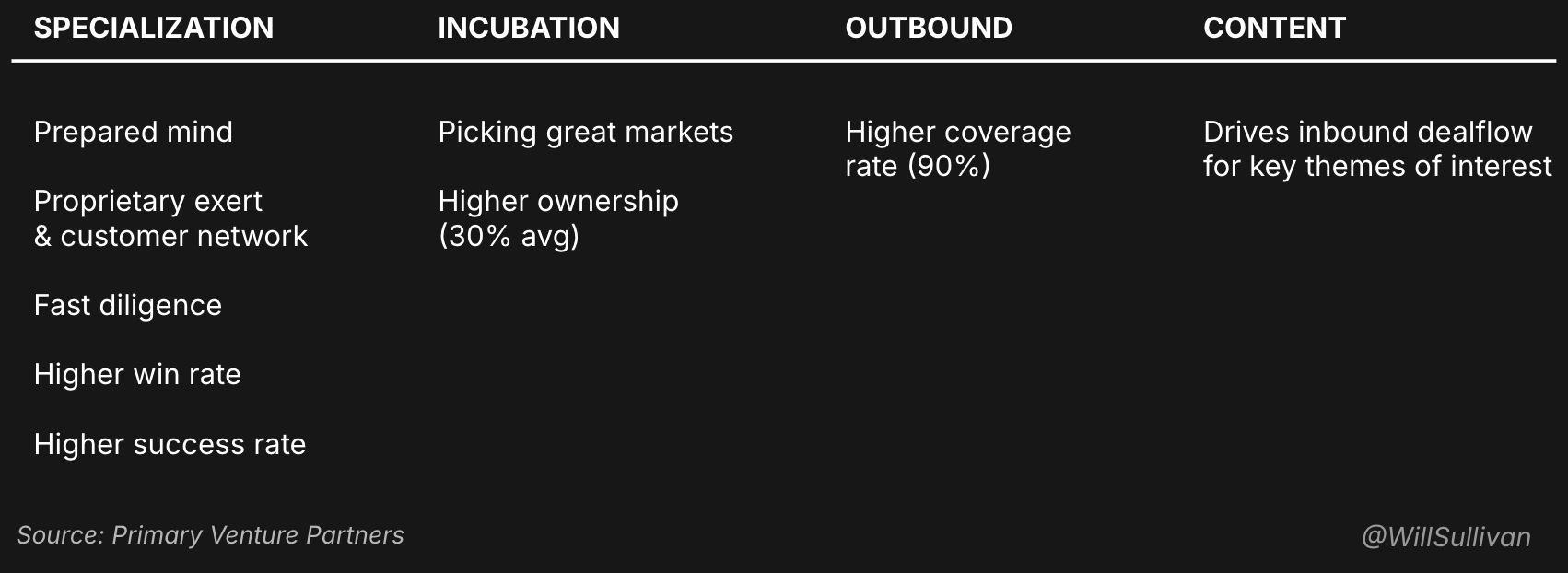
Better investment decisions rely on deliberate strategies like specialization, incubation, outbound sourcing efforts, and content-driven deal flow. Each firm has - or at least claims to have - a unique combination of these approaches.
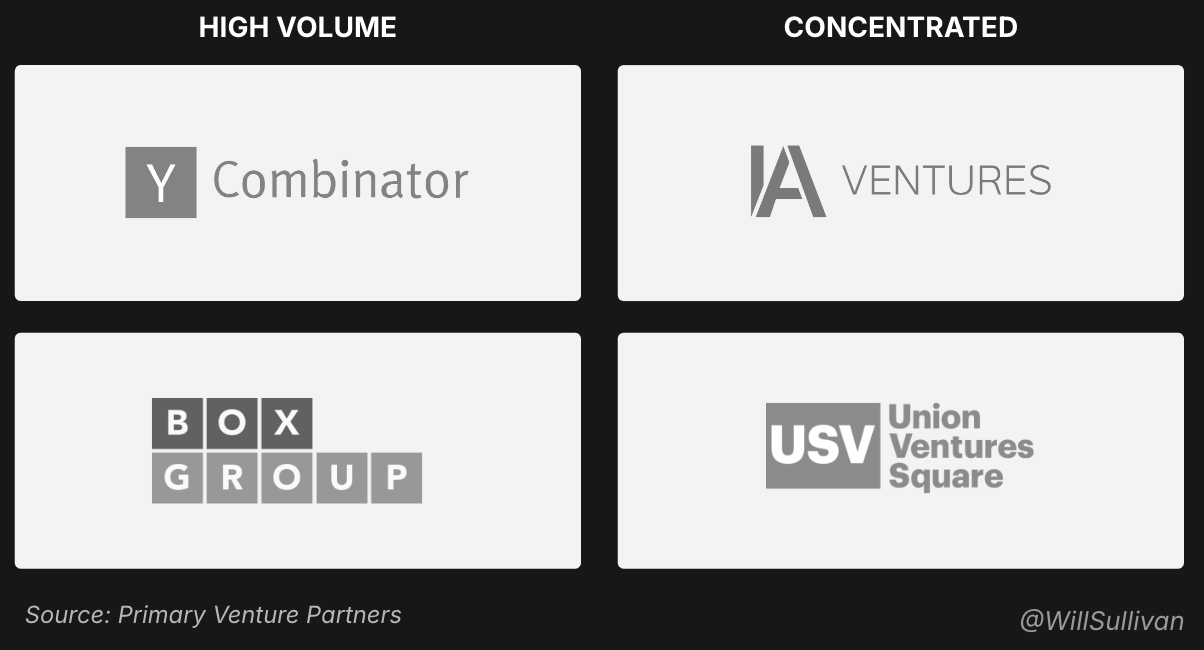
However, there's an important warning: avoid being stuck in the middle. Investment strategies should either embrace high-volume approaches, like Y Combinator, or focus on concentrated bets, like Union Square Ventures (USV).
VC remains a power law business, but the industry has noticeably evolved in the last few years. Recently, the top VCs haven't been seeing the same degree of asymmetry with their funds.
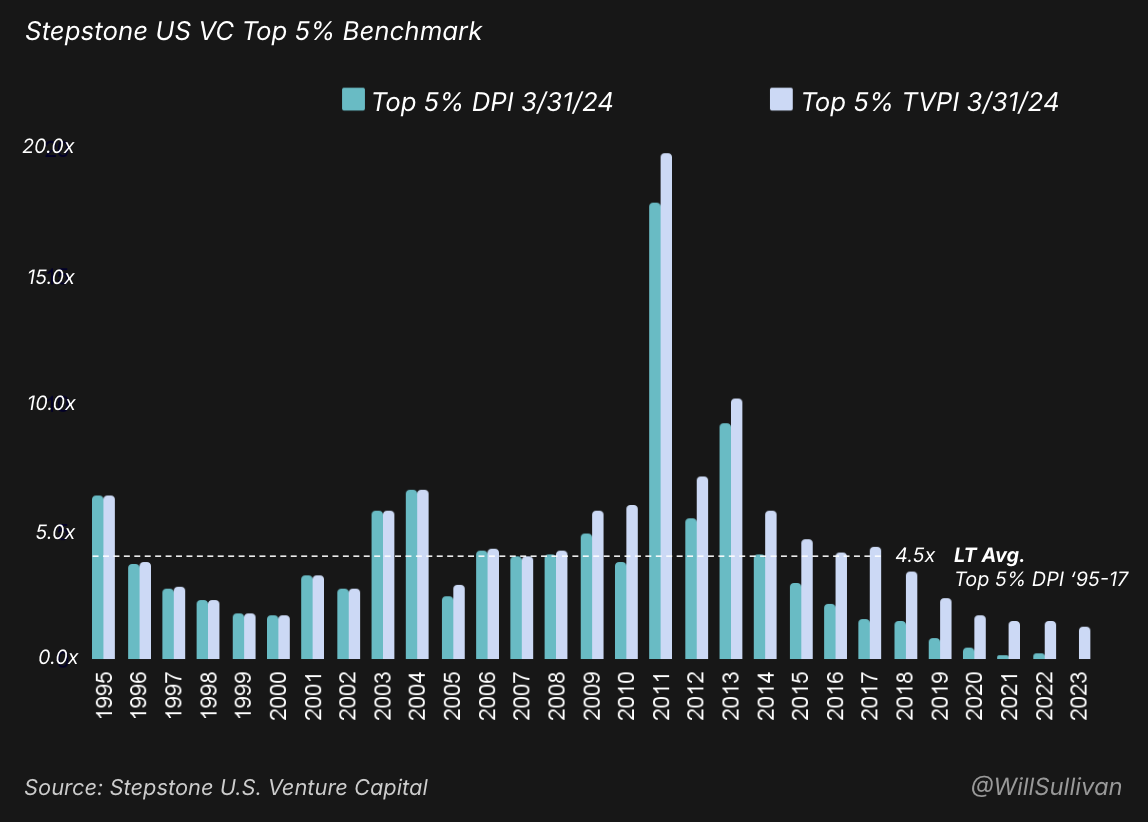
Recent discussions focus on the misaligned incentives that have emerged as venture capital has institutionalized. VC firms have transformed from small, lean teams raising a few million-dollar funds into massive organizations deploying billions annually.
Most funds follow the traditional "2 and 20" compensation structure: a 2% management fee on total assets under management and a 20% performance fee on realized profits. By the numbers, larger fund sizes can lead to guaranteed earnings from management fees, regardless of realized investment returns.
This trend explains the surge in billion-dollar funds. Firms like Andreessen Horowitz, General Catalyst, and Thrive Capital raised $7.2B, $6B, and $5.5B, respectively, this year alone.
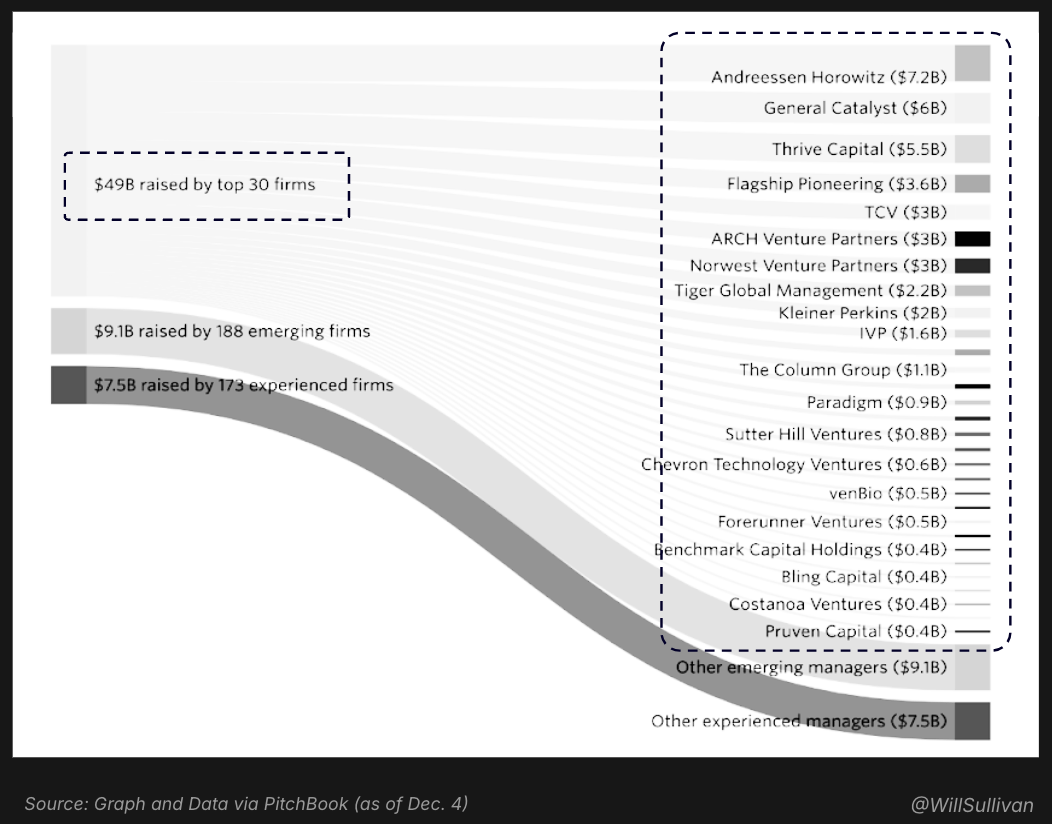
Strategy dictates fund size, and large firms are doubling down on management fee-driven profitability, adopting a "spray and pray" approach - relying on a few big hits to cover widespread losses.
A helpful rule of thumb for VC funds is that they generally need about $2B in "exits" for every $50M they raise. Why? With an average ownership stake of 10% fully diluted, $2B in exits translates to $200M in returns. That's a 4x gross multiple on $50M, which is considered a solid benchmark today. Scaling up, if a VC raises a $300M fund, it would require about $12B in exits - or more - to meet expectations.
As Altimeter Capital's Jamin Ball described in a viral post:
"Venture today has turned into a game of buying deep out-of-the-money call options. Take a swing, hope it works, and if it doesn't, move on to the next swing. Power law outcomes will make it all work.
Unfortunately, this mentality strains the GP/Founder relationship, making it more transactional. The focus shifts to deploying capital rather than actively supporting portfolio companies, especially struggling ones."
Venture capital is about identifying outliers, and there's no systematic way to predict them because each is unique. As Sequoia's Pat Grady noted, "venture is an apprenticeship business. Experienced investors must mentor newer ones, sharing knowledge gained from years of working in the field."
The last few years have proven that top-tier and emerging funds alike are not immune to declining returns. "Tourist VCs" - who raised funds easily during the COVID ZIRP (zero-interest-rate period) - are now struggling to raise follow-up funds and leaving the industry (hence the name "tourist").
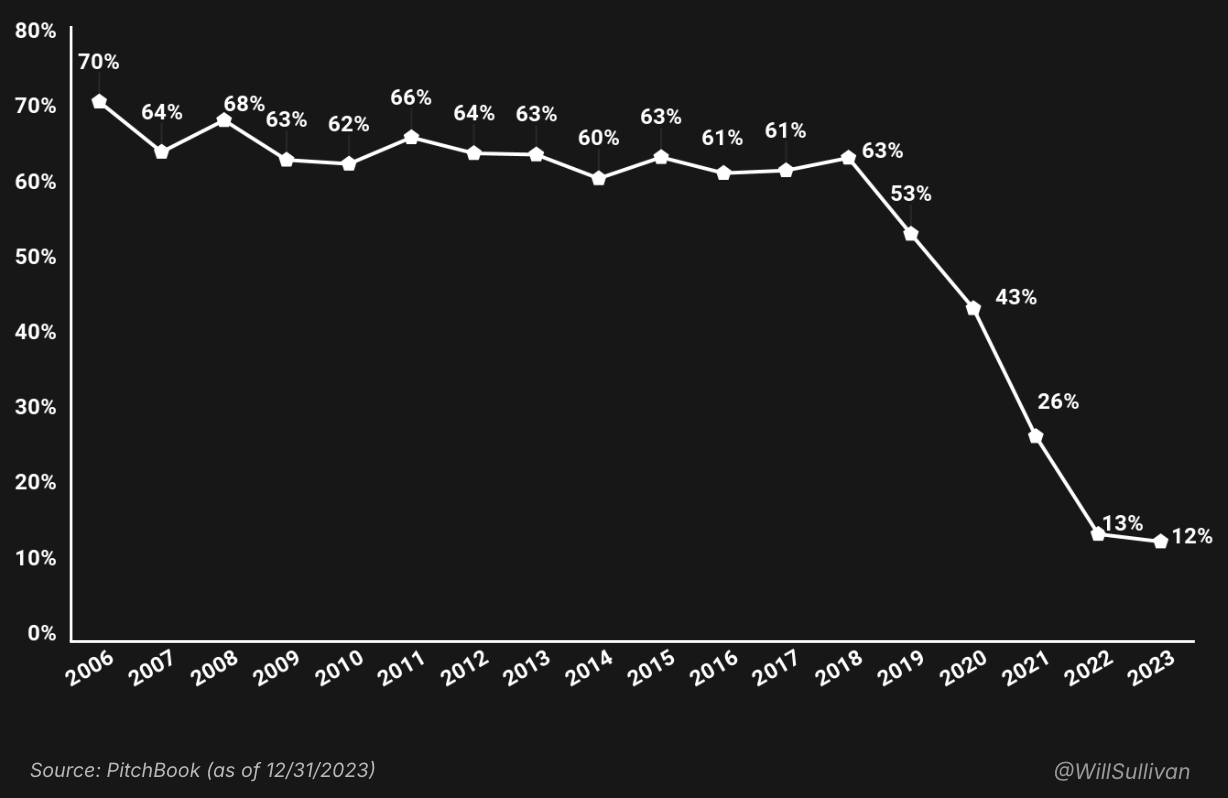
In the end, venture capital remains a gut-driven business shaped by experience, intuition, and an unwavering focus on asymmetric outcomes. While the landscape is more competitive than ever, the power law continues to define the winners.
A version of this article was also published to my weekly email newsletter, The Burn Rate, on December 23, 2024. You can view that version of the article here.