The paradox of choice makes it tough for allocators to decide where to place capital. Learning to choose is challenging, and choosing effectively in a market with seemingly limitless options can feel overwhelming. This often drives investors toward well-known, established managers.
An emerging manager typically refers to GPs with three or fewer funds raised. Despite the appeal of trusted names, limited partners have increasingly been allocating more capital to emerging managers.
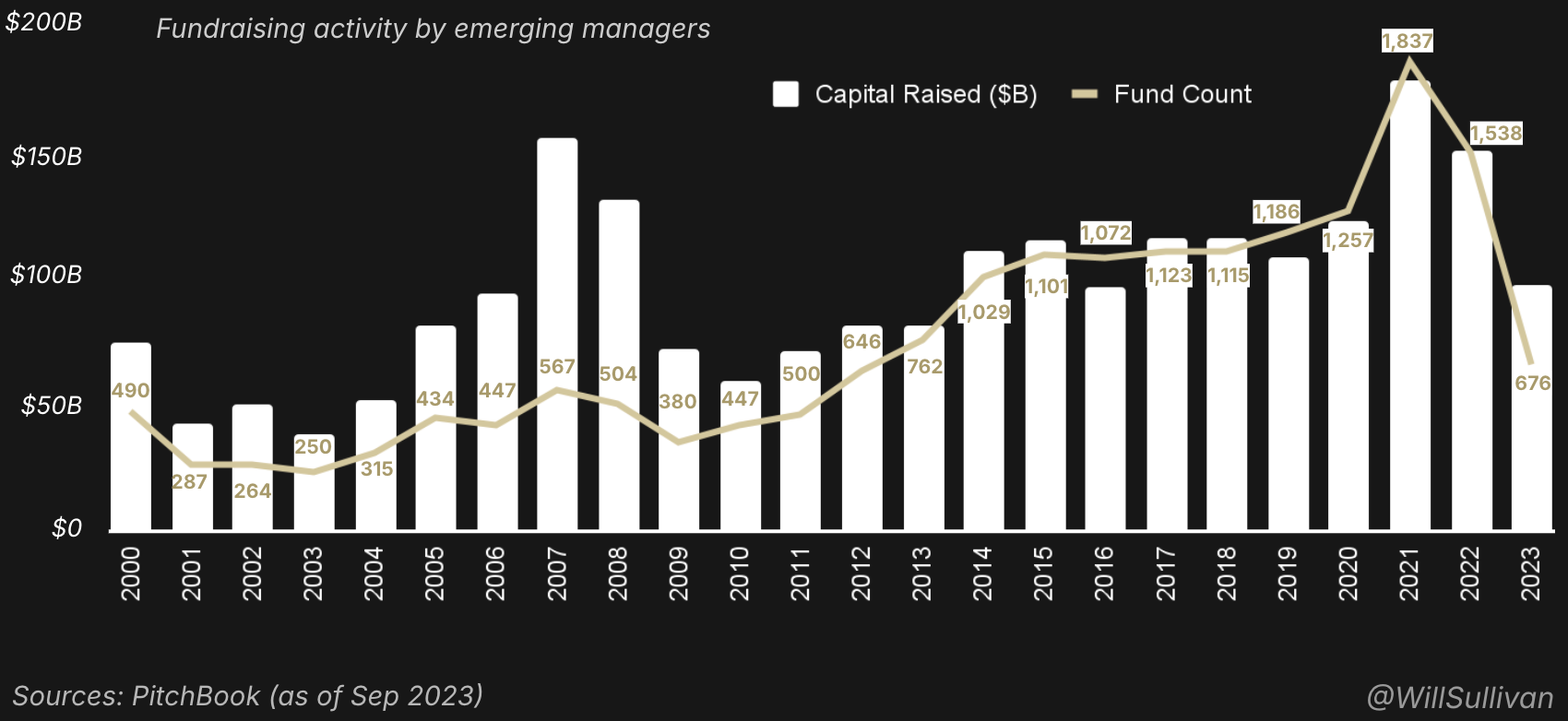
Smaller fund sizes can create more upside potential for GPs, while lower nominal management fees mean performance incentives play a bigger role in compensation. This tends to align GP and LP interests, which is why many allocators dedicate programs specifically for emerging managers. Emerging managers often rely on forward-looking narratives, attractive fee terms, and unique investment theses, such as deep sector or technology expertise.
A natural extension of this focus on alignment and specialized approaches is seen in the growing trend of spinouts. The rise of spinout VCs over the past decade has been described as an unbundling of traditional venture capital.
Several GPs have left pedigreed firms to start their own, including figures like Sunil Nagaraj (from Bessemer Venture Partners to Ubiquity Ventures) and Tomasz Tunguz (from Redpoint Ventures to Theory Ventures).
Others include: Rex Woodbury from Index Ventures, Gaurav Ahuja from Thrive, Blake Robbins from Benchmark, Terri Burns from GV, Amanda Robson from Cowboy Ventures, Anne Lee Skates from a16z, Michelle Volz from a16z, Ken Chenault Jr. and John Monagle from General Catalyst, Bilal Zuberi from Lux Capital, Matt Miller from Sequoia, and Mike Volpi, Bryan Offutt, and Ishani Thakur from Index Ventures.
Spinout managers often emphasize hustle and sweat equity. An example is Chemistry Ventures, founded by Mark Goldberg of Index, Kristina Shen of a16z, and Ethan Kurzweil of Bessemer, with an internal memo highlighting plans to "out-hustle the legacy firms that have grown distracted by scale."
Beyond just hustle, many emerging managers bring a sense of bold, naive optimism - an outlook that Kirsten Green, Founder and Managing Partner of Forerunner Ventures, sees as a crucial advantage:
"The reality is that what worked yesterday is not what will work tomorrow. The whole point of our business is building new things. So, I think that looking to the past to inform the future is not the right playbook or architecture to use."
"I remember thinking early on that my lack of experience was a disadvantage, and I was moving at a fast pace to accomplish a lot. One of the things I wanted to gain was experience because I believed that once I had it, I would be better, more relevant, and more capable."
"Now, as I think about the next ten years and what it will take to excel, I realize that I benefit from the experience I've gained."
Mark Suster, Partner at Upfront Ventures, emphasizes the value of youthful optimism in venture capital, especially when it challenges conventional thinking:
"As an investor, the older you get and the more failures you've seen, the easier it becomes to write off why something won't work. At Upfront, a lot of my investors are younger, and I love that younger voice that challenges me - saying, 'Mark, you don't understand, it's different now.' I think that naïve optimism matters."
"What the founders you're backing are building things shouldn't work. It probably won't work. But the founders are just a little too naive to realize that - so they try to do something that most people would say is impossible."
"And by being a little naive and not accepting conventional wisdom, some of them break through and achieve it. I even use it as a metaphor for the United States. Europe has had structured societies for thousands of years, to the point where people start with reasons why something won't work."
"But sometimes, Americans are just naive enough to say, 'Oh, we're going to do this, and it's going to work.' Most of the time, we're wrong. But that naivete produces things like SpaceX. It's just like venture capital - what others, especially in Europe, say would never work."
Looking again at the data, it is reasonable to anticipate that a larger share of top-performing funds could emerge from newer managers because of smaller fund sizes and earlier-stage focus. Many of the standout performers come from emerging managers, but these managers have historically shown a broader range of outcomes with lower consistency.
Across multiple vintage years, starting just before the dot-com bubble, emerging managers regularly surpassed their established peers in median internal rate of return (IRR) - a metric that measures the annualized return of an investment fund.
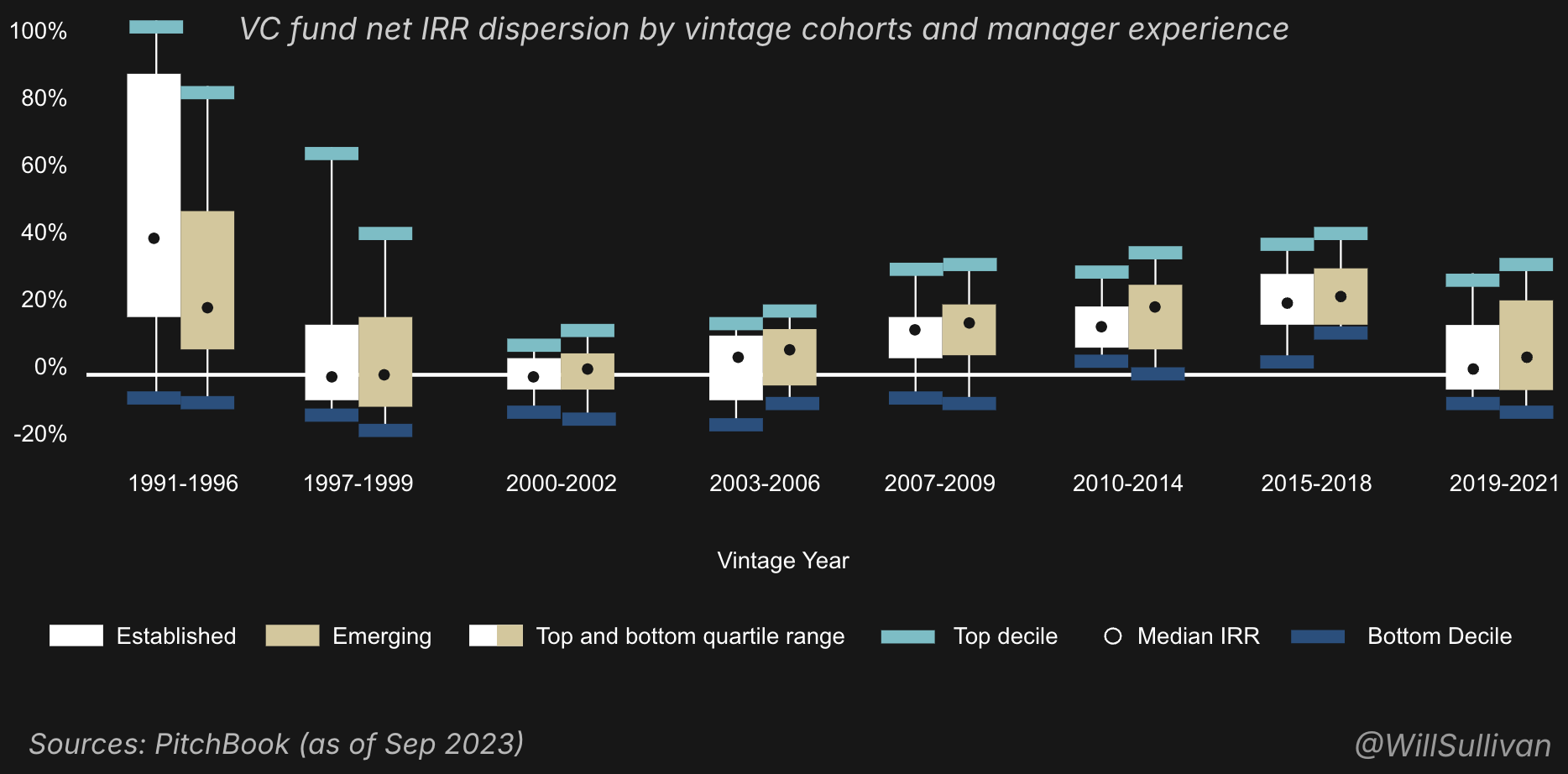
Although this cohort delivers some of the highest outperformance, the returns can also be more volatile. They do tend to outperform but with a broader performance spectrum.
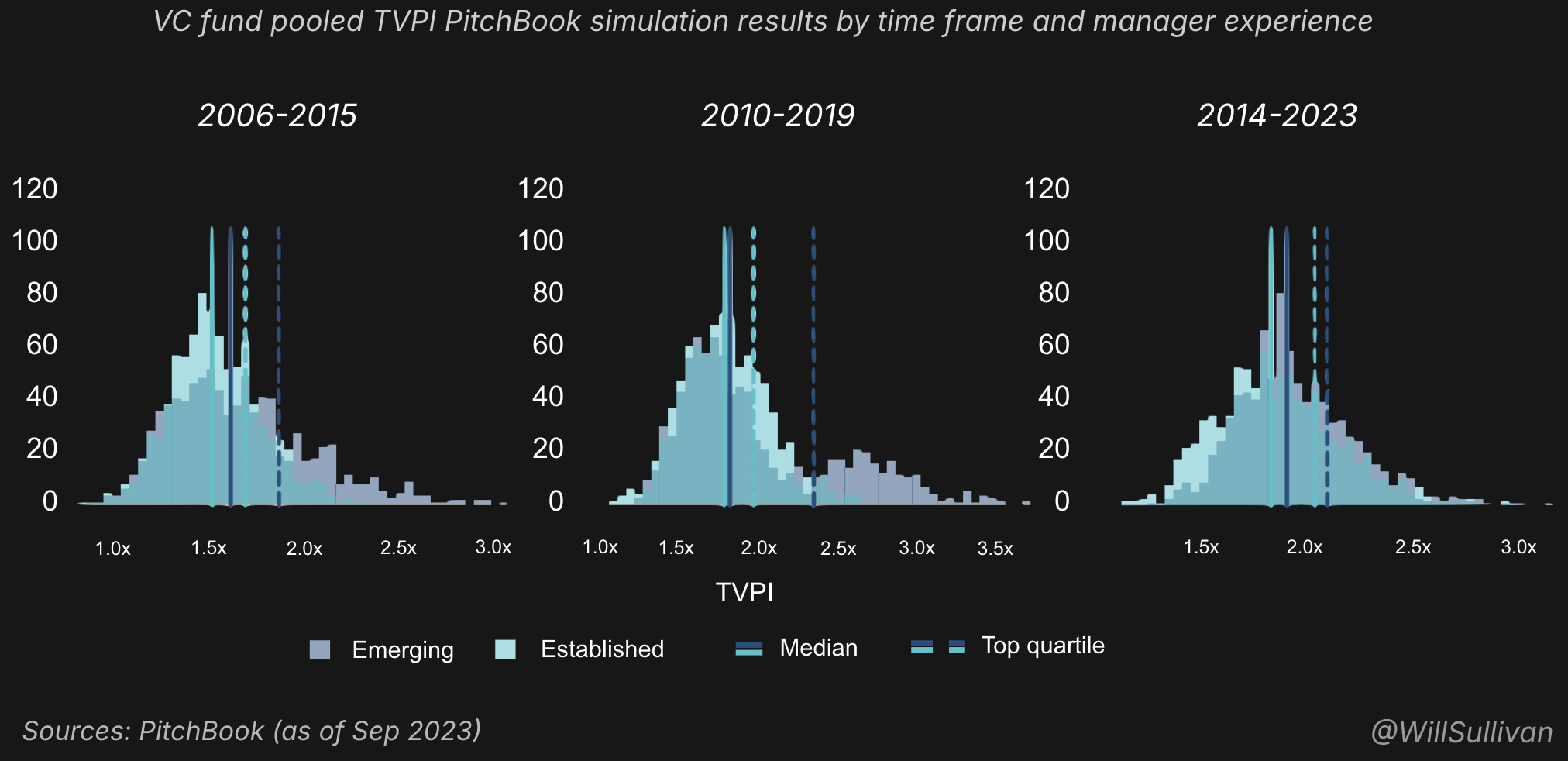
Specialists also play a key role in this conversation. Both emerging and established specialist (sector-focused) funds have consistently achieved stronger returns.
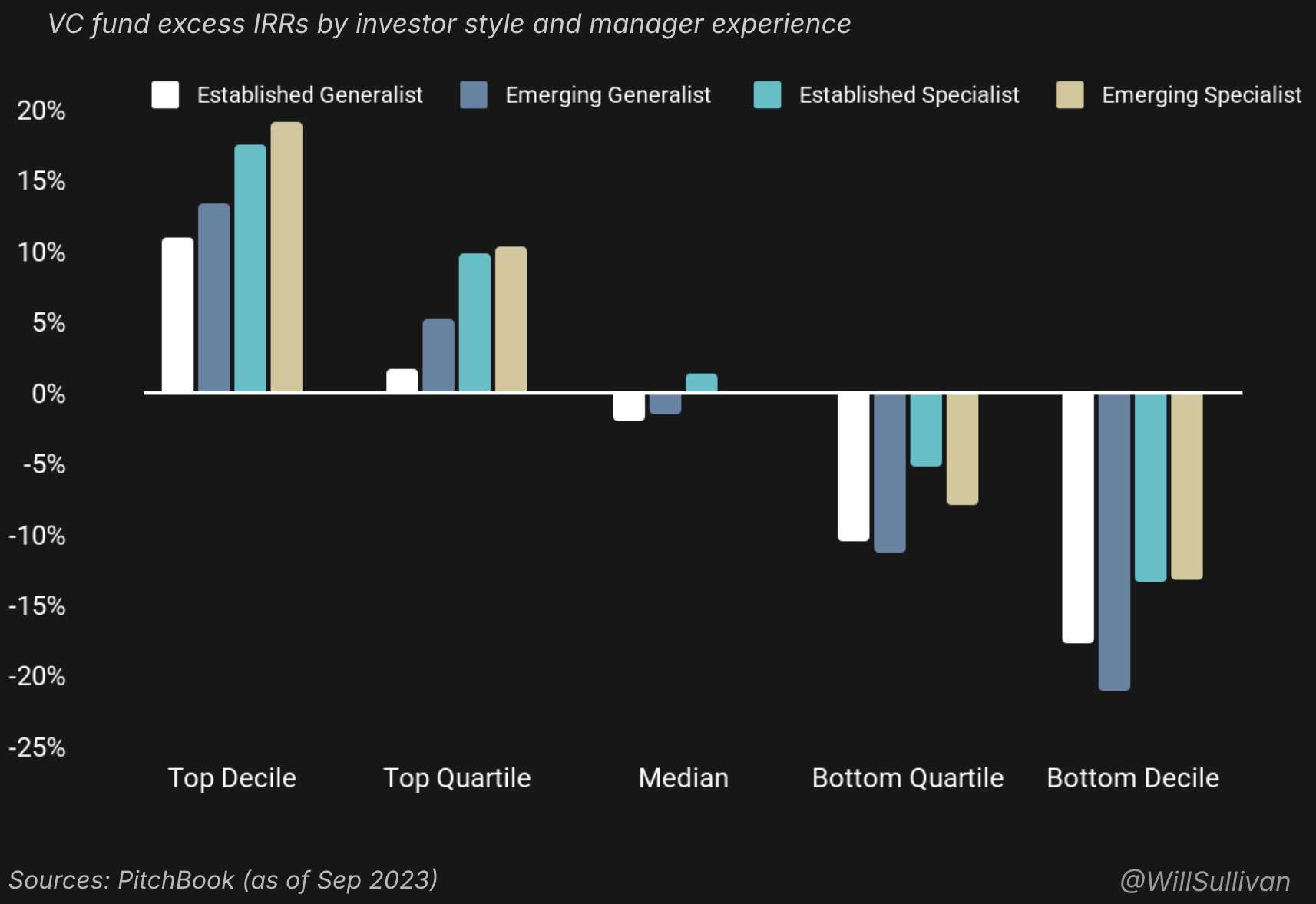
Sector-focused managers often benefit from deeper technical expertise and unique sourcing advantages. Established managers with fund sizes exceeding $250 million can offer stable returns, yet their upper limit for outsized performance tends to be capped.
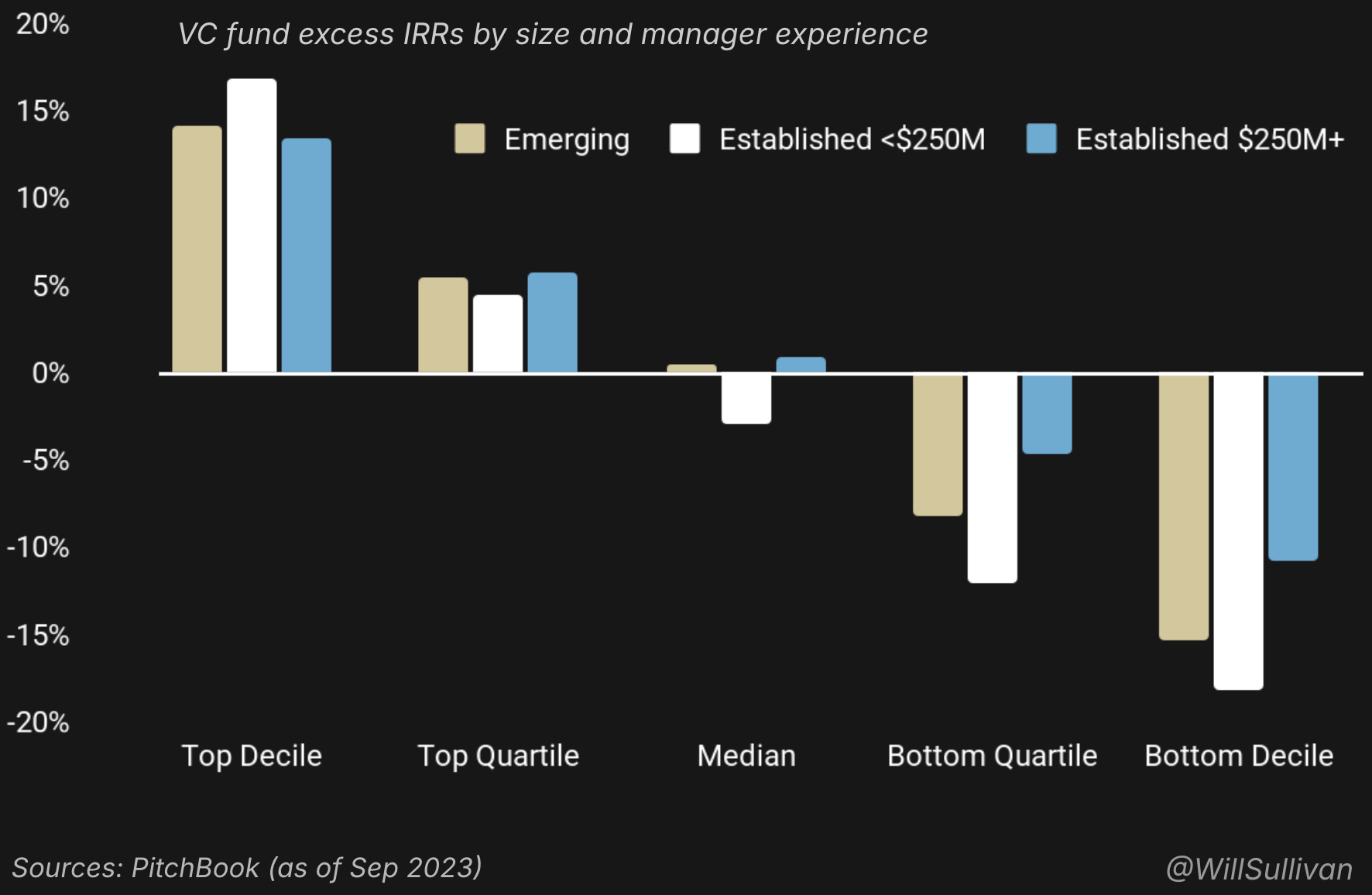
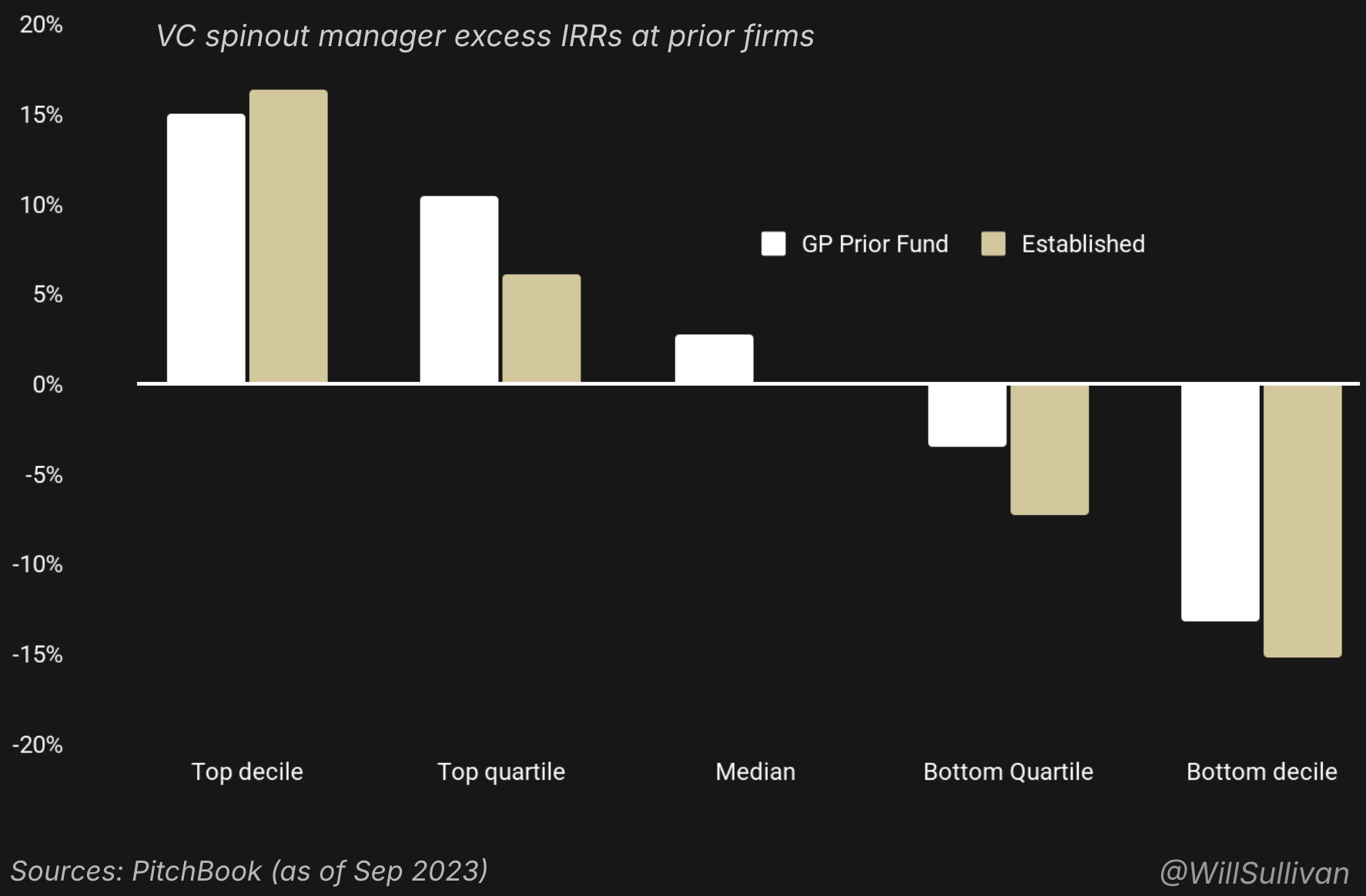
For top-decile VC funds, the best-performing emerging managers have achieved 15.9% in excess IRR, which is higher by 3.6% and 3.0% compared to established and other emerging managers, respectively. While that is true, established firms often help LPs mitigate downside risk more effectively than newer managers.
Emerging managers can offer significant upside potential or access to distinctive strategies not easily reproduced by larger firms. While they may carry higher risk, there's something special about the up-and-coming asset manager class - with their hustle, naïve optimism, and outsized returns - that reaffirms there is indeed a place in the market for emerging managers.
Special thanks to PitchBook for providing the included data.
A version of this article was also published to my weekly email newsletter, The Burn Rate, on February 3, 2025. You can view that version of the article here.